

Companies do not build thought leadership by publishing more content. They build it by setting an authority agenda around the problems their industry needs to solve.
That matters because the market is already crowded. AI has made it easy to produce articles, summaries, posts, and search-optimized material at a pace no editorial team could match. Some of that material is useful. Much of it is forgettable. A growing share falls into what people now call “AI slop”: high-volume, low-value content made more for algorithms than for readers.
Research on AI-generated content shows that AI-written and AI-assisted material now appears across publishing platforms, search results, social feeds, and content-farm ecosystems.
For companies with real expertise, this creates a positioning problem.
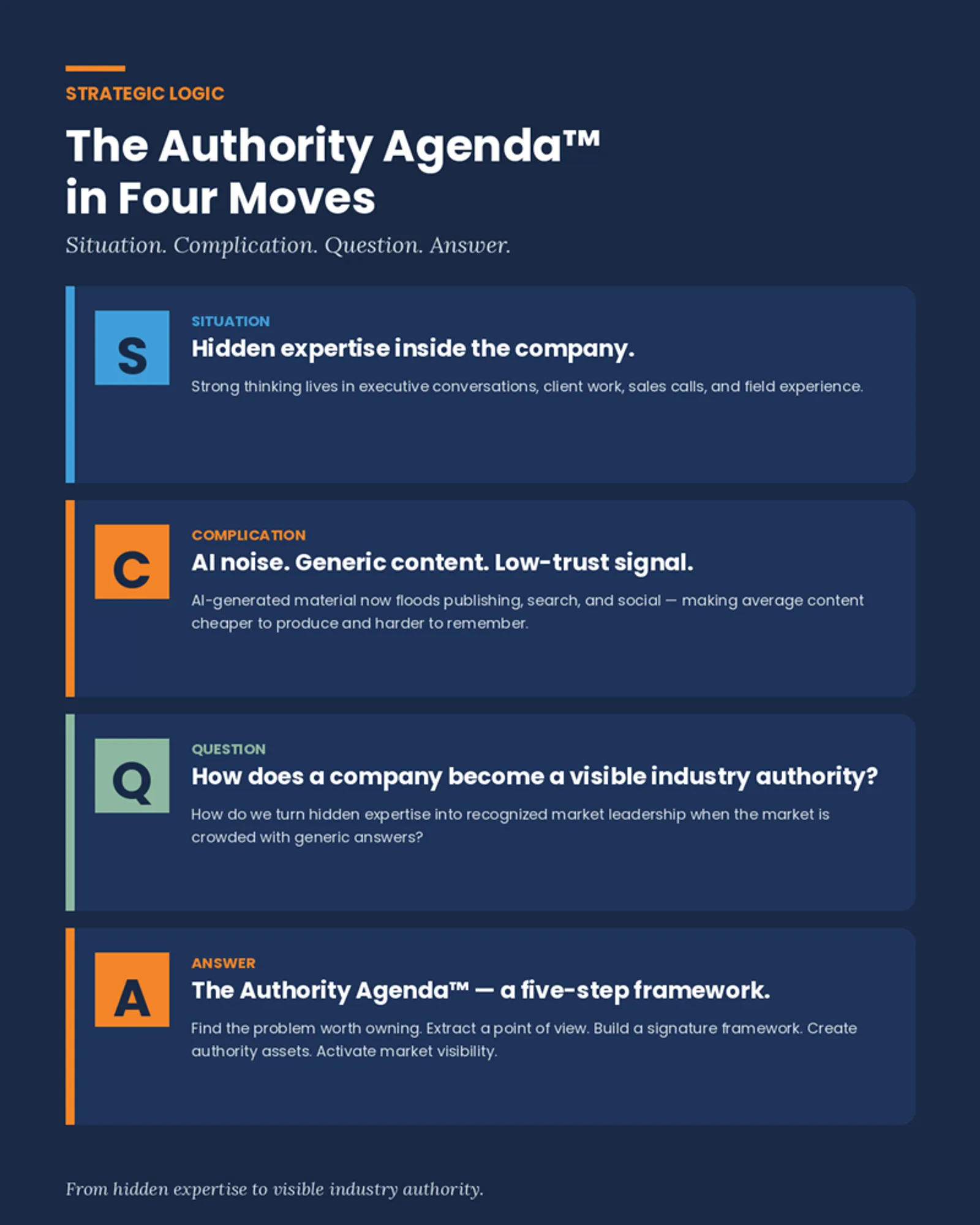
Most companies already have strong thinking inside the business. It shows up in executive conversations, client work, internal research, sales calls, board discussions, strategy decks, and lessons learned from the field. The market rarely sees that thinking in a form it can understand, remember, and repeat.
So the right question is not, “How do we publish more?”
The better question is:
How do we turn hidden expertise into visible industry authority when the market is crowded with generic answers?
That is the purpose of The Authority Agenda™.
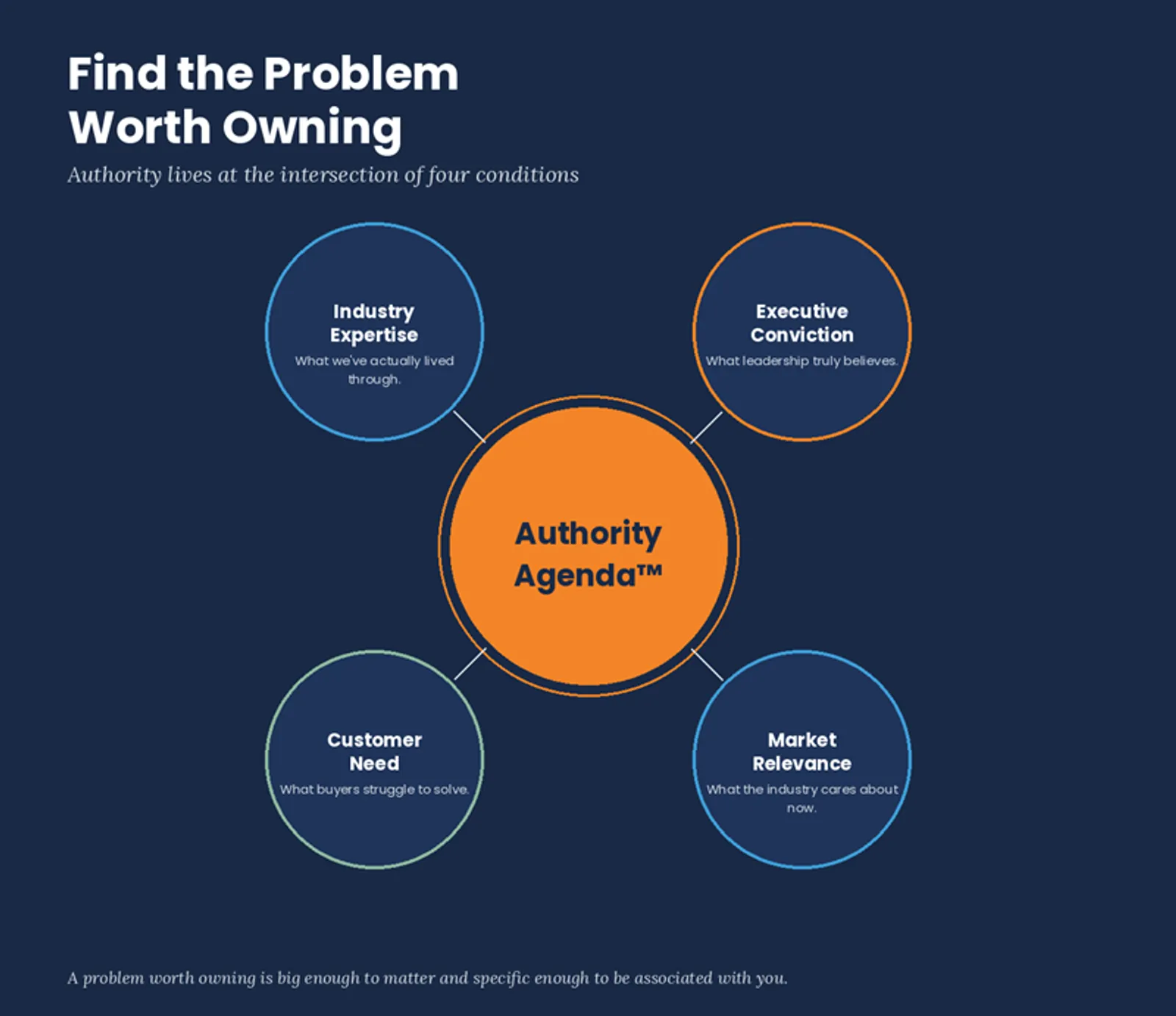
The Authority Agenda™ is a five-step framework for helping companies identify a problem worth owning, extract an original point of view, build a signature framework, create authority assets, and make the company’s thinking visible to the right market.
Why More Content Does Not Create More Authority
AI has made average content easier to produce
AI has changed the economics of content. It can generate an article outline, a webinar summary, a LinkedIn post, an email sequence, and a batch of search-friendly variations in minutes.
That speed helps when a company already has a strong point of view. Without one, it can flood the market with more polished sameness.
A Graphite analysis of AI-generated web articles found that AI-generated articles had surpassed human-written articles in a large sample of English-language web content, while noting that the share later appeared to plateau. The right takeaway is not that every corner of the internet is AI-written. It is that AI content is now common enough to affect how audiences judge quality.
When readers encounter more generic content, they get faster at scanning past anything that feels familiar.
AI slop raises the value of real expertise
The rise of AI slop creates an opening for companies with substance.
Generic AI content often sounds smooth. That is part of the problem. It can summarize common advice, repackage obvious ideas, and imitate authority without adding judgment. The writing may be clean, but the thinking often feels borrowed.
That is not thought leadership.
Thought leadership means sharing original, valuable ideas that help move an industry forward by answering its biggest questions. In our webinar on this topic, we made a simple point: most professionals and companies do not have an expertise problem. They have a visibility problem. Their thinking is under-structured, under-distributed, and too often buried inside the organization.
In a noisy content market, the audience needs to understand what your company stands for. That recognition comes from a specific problem, a clear point of view, and a practical way of explaining the company’s thinking.
Trust depends on human judgment
Audiences are cautious about public-facing AI content, especially when the stakes are high. Reuters Institute research on public attitudes toward AI in journalism shows that people place more confidence in human-led work than in content produced mostly by AI.
Corporate thought leadership should take that signal seriously. AI can help organize, draft, repurpose, and scale. It should not be asked to invent the company’s judgment.
Authority comes from what leaders have seen, what customers keep asking, where the market is confused, and what the company believes should happen next.
What Is The Authority Agenda™?
A company-level framework for market leadership
The Authority Agenda™ helps companies build visible industry authority by identifying a problem worth owning, developing an original market point of view, codifying that thinking into a signature framework, and putting that idea in front of the right audience with consistency.
It is built for executive teams, CMOs, senior marketing leaders, and corporate communications teams that need to turn internal expertise into external influence.
The key word is agenda.
A company with an agenda is making a choice. It is deciding which conversation it wants to lead, why that conversation matters, and what it wants the market to understand differently.
The agenda comes before the content
Many organizations start with a familiar planning question:
“What should we publish this month?”
That question gets the team moving, but it does not guarantee the work will build authority.
A better question is:
What problem should our company help the industry understand and solve?
That question changes the role of the content calendar. Instead of starting with topics, formats, and deadlines, the team starts with the market conversation it wants to lead. The calendar then becomes a distribution plan for the company’s point of view, not a running list of disconnected posts, campaigns, and executive updates.
Authority is built around what the market remembers
Companies become easier to remember when they connect themselves to a specific market problem and a distinct point of view.
Broad themes rarely do that on their own. “Innovation,” “transformation,” “growth,” and “resilience” are easy to claim because they are too broad to mean much without context. The stronger move is to tie one of those themes to a problem the market already recognizes.
The Authority Agenda™ helps companies narrow the field. It asks: What is the problem we are willing to address in public? What do we believe about it? How do we explain it in a way the market can repeat?
Step 1: Find the Problem Worth Owning
Start with market tension, not content topics
The first step is to identify the industry problem, question, or tension your company is uniquely qualified to address.
That problem may come from a costly inefficiency customers have learned to tolerate. It may be a risk the market keeps underestimating. It may be a shift buyers know is coming but cannot yet explain. It may be a recurring point of confusion that competitors discuss in vague terms.
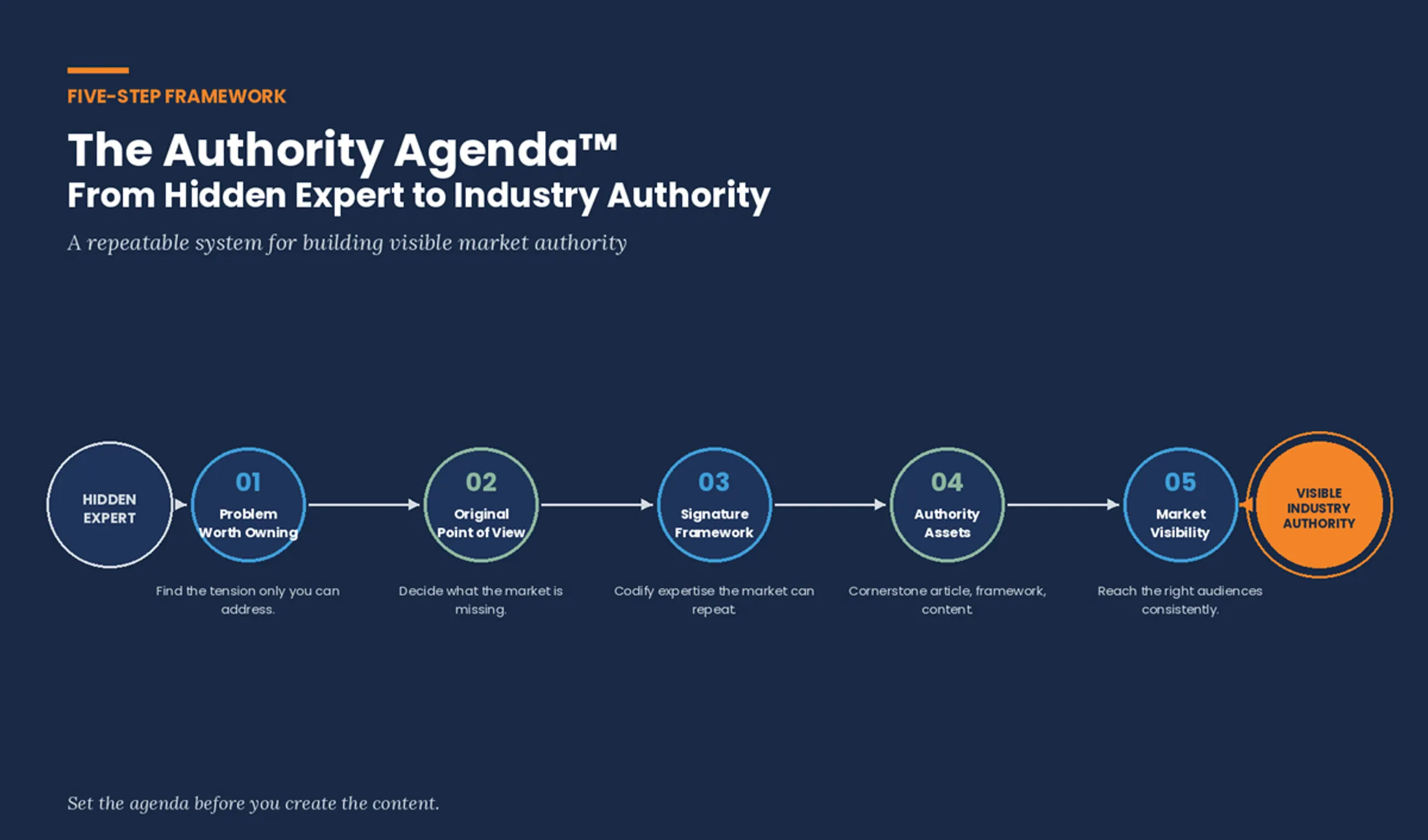
The problem should be big enough to matter and specific enough to be associated with your company.
This is where many companies miss. They choose a theme because it sounds marketable. Then they wonder why the content blends in.
Choose a problem your company has earned the right to address
A strong authority agenda sits at the intersection of market need, company expertise, executive conviction, and customer relevance.
If the market does not care about the issue, the content will struggle no matter how polished it is. If the company has no real experience with the issue, the point of view will feel thin. If leadership does not believe the argument, the message will sound borrowed.
In our webinar, we emphasized that authority grows when the market associates a company with a specific problem rather than a broad specialty. The goal is not to “own” the problem in a possessive sense. The goal is to become one of the voices the market trusts to explain it, frame it, and point toward a better path.
A company should be able to say, in plain language:
“This is a problem our industry needs to solve. Here is why it matters. Here is what we see that others are missing.”
Avoid broad themes that dilute authority
A company that says it leads on “digital transformation” is entering a crowded room. A company that explains why digital transformation fails in a specific industry, at a specific decision point, because of a specific operating blind spot has a stronger claim.
The more concrete the problem, the easier it is for the market to understand why your company has earned the right to be part of that conversation.
Step 2: Extract the Original Point of View
Thought leadership requires a stance
A problem worth owning is the starting point. The company still needs a point of view.
What does leadership believe? What does the company challenge? What does it see that others miss? Where does customer experience contradict the conventional advice in the market?
A strong point of view does not need to be loud. It needs to be useful. It should help the market see the problem more clearly than it did before.
The strongest perspective comes from lived experience
The best source material is usually already inside the company. It shows up in executive interviews, customer conversations, sales patterns, internal data, implementation lessons, research, and frontline observations.
This step matters because companies often underestimate what they know. They assume the market already understands the issue. It often does not. What feels obvious internally may be exactly what customers, journalists, analysts, and peers need explained.
AI can organize thinking, but it cannot own judgment
AI can help sort interview notes, cluster themes, compare research, and draft early outlines. That is useful.
But AI cannot decide what the company believes. It cannot know which customer pattern matters most. It cannot carry the weight of executive judgment.
When AI originates the thinking, the result often sounds like everything else. When AI supports real expertise, it helps good ideas travel farther.
Step 3: Build the Signature Framework
A framework makes expertise visible and repeatable
A signature framework turns scattered expertise into a model the market can understand, remember, and repeat.
This is where thought leadership becomes more than a series of opinions. The framework gives the company thinking structure. It creates shared language for executives, marketing, communications, sales, customers, and partners.
Without a framework, strong ideas often stay trapped in long-form content or one-off conversations. With a framework, the company gives the market a handle.
The model should simplify without becoming simplistic
A good framework makes complex expertise easier to grasp without flattening the thinking.
It should be clear enough to explain in a few minutes. It should be visual enough to remember. It should be flexible enough to support articles, webinars, speeches, and sales conversations. It should also be specific enough that the market associates it with the company’s point of view.
The framework becomes the company’s signature asset
Once built, the framework becomes the center of the authority agenda.
It can support a cornerstone article. It can become the spine of a keynote. It can guide a webinar series, executive LinkedIn content, a media pitch, a sales conversation, and internal messaging.
That is why this step matters. A strong framework makes the company’s thinking easier to recognize.
Step 4: Create the Authority Assets
The cornerstone article explains the agenda
The cornerstone article introduces the market problem, explains the company’s point of view, and presents the signature framework.
It should not read like a product pitch. A real cornerstone article makes the market smarter. It gives readers language, structure, and perspective they can use, even before they ever become buyers.
The article becomes the central asset that other content points back to.
Supporting assets bring the idea into more market conversations
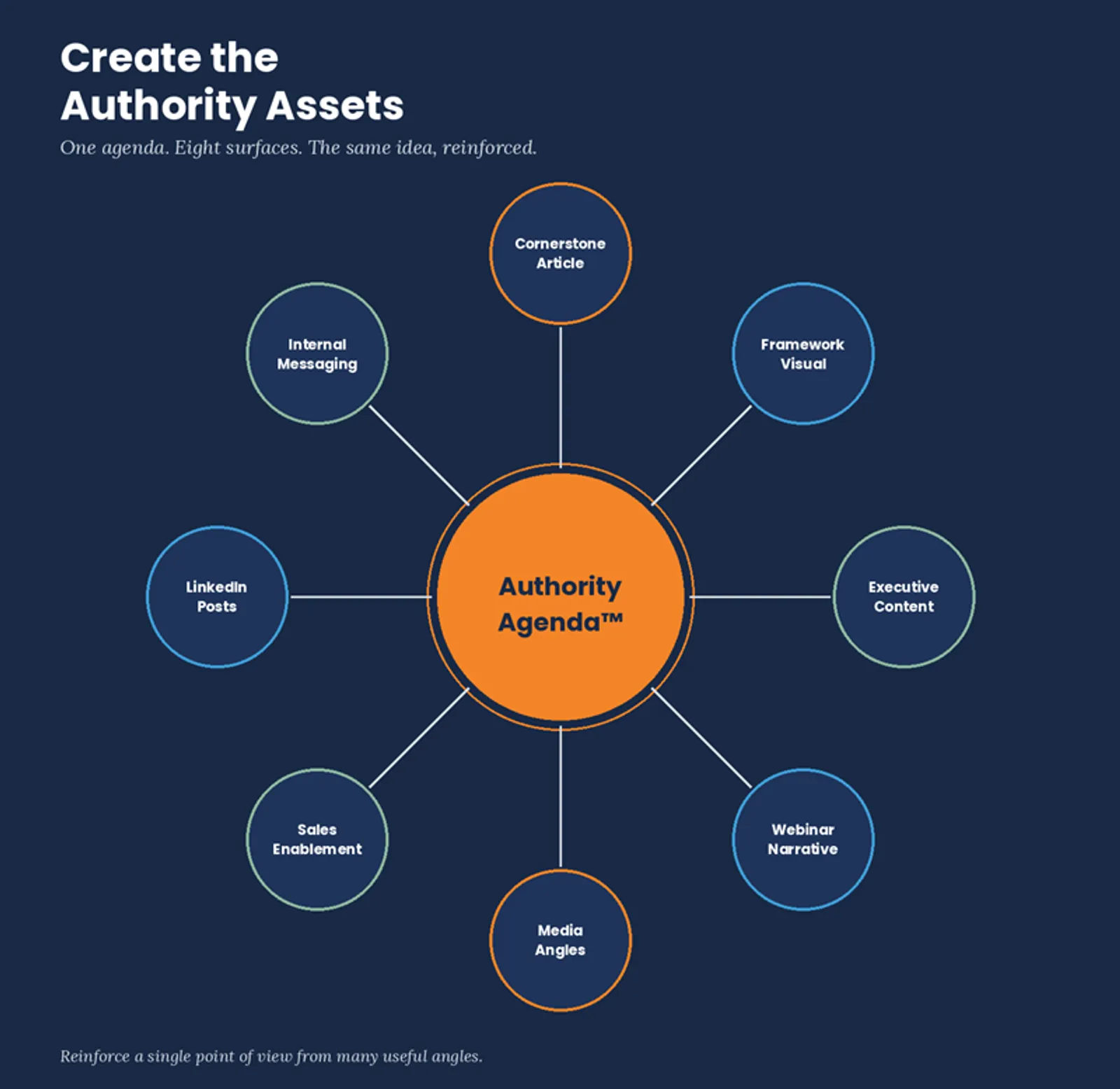
Authority assets are reusable strategic assets that help the company’s thinking show up in the places where the audience already pays attention.
They may include the framework visual, executive posts, webinar narratives, media angles, LinkedIn content, sales enablement language, internal messaging, and industry presentations.
The point is not to create endless variations. The point is to reinforce the same idea in the places where the right audience is already looking for useful insight.
Consistency matters more than content volume
A company does not need fifty disconnected posts. It needs a clear point of view reinforced from several useful angles.
Edelman and LinkedIn research on B2B thought leadership impact shows that decision-makers use thought leadership to evaluate vendors, build trust, and understand whether a company brings real value to the table.
That is the job of authority assets. They help the right people encounter the company’s thinking before the first direct conversation.
Step 5: Activate Market Visibility
Authority grows when the right audience sees the idea
A company’s expertise has to reach the people who shape its market.
That audience may include buyers, partners, analysts, journalists, employees, investors, board members, regulators, or industry peers. The authority agenda should appear in the places where those audiences already look for ideas and direction.
A brilliant point of view that no one sees does not shape the market.
Distribution should follow the audience, not the algorithm
Too many companies publish and hope the algorithm cooperates. That is not a visibility strategy.
A stronger approach uses executive publishing, company channels, LinkedIn engagement, PR, webinars, speaking opportunities, newsletters, analyst conversations, targeted promotion, and sales enablement.
The goal is repeated exposure with the right people around the right idea. Broad reach may help, but it is not the main prize.
Market response sharpens the agenda
Once the agenda is in market, the company should listen carefully.
Comments, sales conversations, webinar questions, media interest, and customer objections all reveal what is landing and what needs sharper language. The market will often tell you where the argument is strongest.
The Authority Agenda™ is not a one-time campaign. It is a repeatable system for building recognition around the problems your company is best positioned to address.
The Role of AI in The Authority Agenda™
Use AI to accelerate, not originate
AI has a valuable role in this work. It can help organize research, identify patterns, draft outlines, repurpose long-form content, build content calendars, and adapt assets for different audiences.
Used well, AI reduces friction. It helps teams move faster without starting from a blank page.
Protect the human insight at the center
The center of the agenda should remain human.
The best thought leadership comes from judgment, experience, customer understanding, and conviction. That is the material AI cannot manufacture.
This matters even more in a market shaped by AI slop. As more generic content enters the system, real expertise becomes easier to recognize when it is well structured and clearly expressed.
Avoid polished generic content
The danger of AI is not always bad writing. More often the danger is smooth writing that says very little.
The Authority Agenda™ creates quality control by putting strategy before production. The company defines the problem, clarifies the point of view, builds the framework, and then creates the assets.
That sequence keeps the work from becoming another polished but forgettable contribution to the noise.
How to Put The Authority Agenda™ to Work
Treat the agenda as a strategic asset
The Authority Agenda™ should not live in a slide deck that gets revisited once a quarter. It should become a working asset for leadership, marketing, communications, sales, and subject matter experts.
Once the company has defined the problem, point of view, framework, assets, and visibility plan, the agenda should guide what the company publishes, where executives show up, which media opportunities matter, and how teams talk about the market.
This is where the framework earns its keep. It gives teams a shared reference point, so thought leadership does not depend on whoever happens to be writing, posting, pitching, or presenting that week.
Build a repeatable rhythm
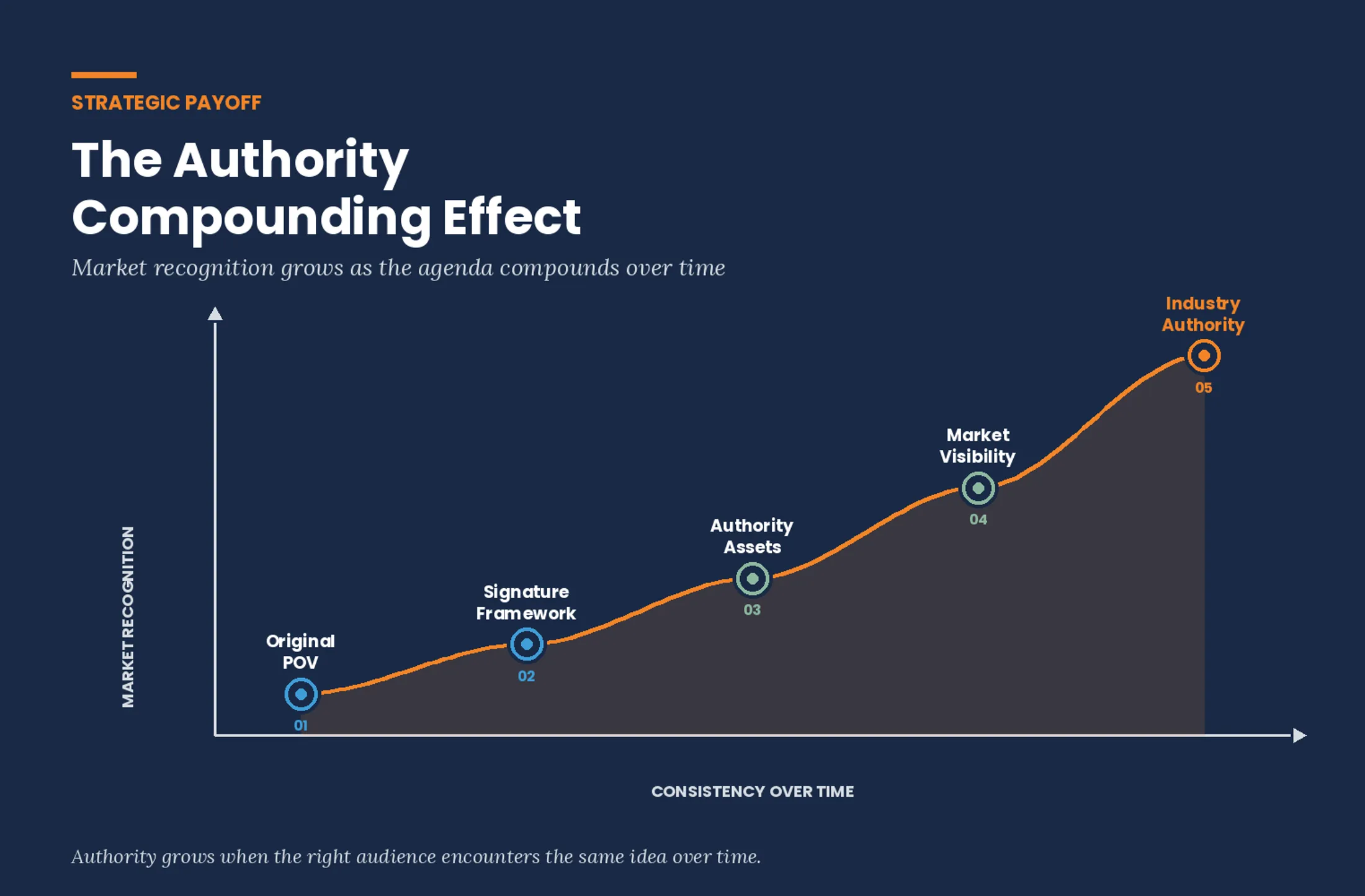
Authority grows when the market encounters the same core idea in useful ways over time.
That does not mean repeating the same post every week. It means returning to the same problem from different angles. One month, the company may publish the cornerstone article. The next, executives may share field observations that support the point of view. A webinar may explore the framework in more depth. A sales team may use the same language in customer conversations.
The message begins to stick because the market sees a consistent agenda, not a collection of unrelated updates.
Keep refining the agenda
A strong authority agenda should be stable, but not frozen.
The market will respond. Customers will ask better questions. Sales teams will hear objections. Journalists and analysts may focus on one part of the argument more than another.
That feedback should sharpen the agenda over time. The goal is not to chase every reaction. The goal is to make the company’s point of view clearer, more relevant, and harder to ignore.
The Strategic Payoff of Setting an Authority Agenda™
Recognition before the first conversation
A clear authority agenda helps the market understand what your company stands for before a buyer, analyst, journalist, or partner speaks with your team.
That matters because many important decisions are shaped before a formal evaluation begins. Buyers develop preferences. Analysts form opinions. Journalists look for sources. Partners notice who has a useful point of view.
The company enters those conversations with a clearer reputation.
Trust before the buying process
Strong thought leadership helps buyers assess the quality of a company’s thinking. It also reaches people who influence decisions without always appearing in the sales process.
The Edelman and LinkedIn research on B2B thought leadership impact reinforces this point. High-quality thought leadership can shape trust, alignment, and vendor evaluation before a company enters a formal conversation.
Influence over how the market defines the problem
The deepest value of thought leadership is influence.
Companies that set an authority agenda help define what the market should pay attention to, why the issue matters, and how leaders should think about what comes next.
That is a stronger ambition than publishing content. It is also a better use of executive expertise.
Set the Agenda Before You Create the Content
Companies do not build thought leadership by publishing more content. They build it by setting an authority agenda around the problems their industry needs to solve.
In a market crowded with generic content and AI-generated noise, the advantage shifts to companies with real expertise, clear judgment, and a point of view worth following.
The companies that become visible industry authorities are not always the ones who publish the most.
They are the ones who turn their expertise into an agenda the market can see, understand, and trust.