

B2B podcasts have moved from experimental content format to serious strategic channel. The case is clear in TopRank Marketing’s original article, “B2B Podcasting: 20 Stats that Make the Marketing Case”, which shows why podcasting deserves attention from B2B marketers. The larger opportunity for companies is even more important: podcasts can help turn executive expertise, customer insight, and market perspective into a repeatable thought leadership system. For firms competing on trust, authority, and complex ideas, podcasting is no longer only about audience growth. It is about building a visible voice in the market.
The B2B Podcast Audience Is Now Too Large to Ignore
Podcast consumption has reached mainstream scale
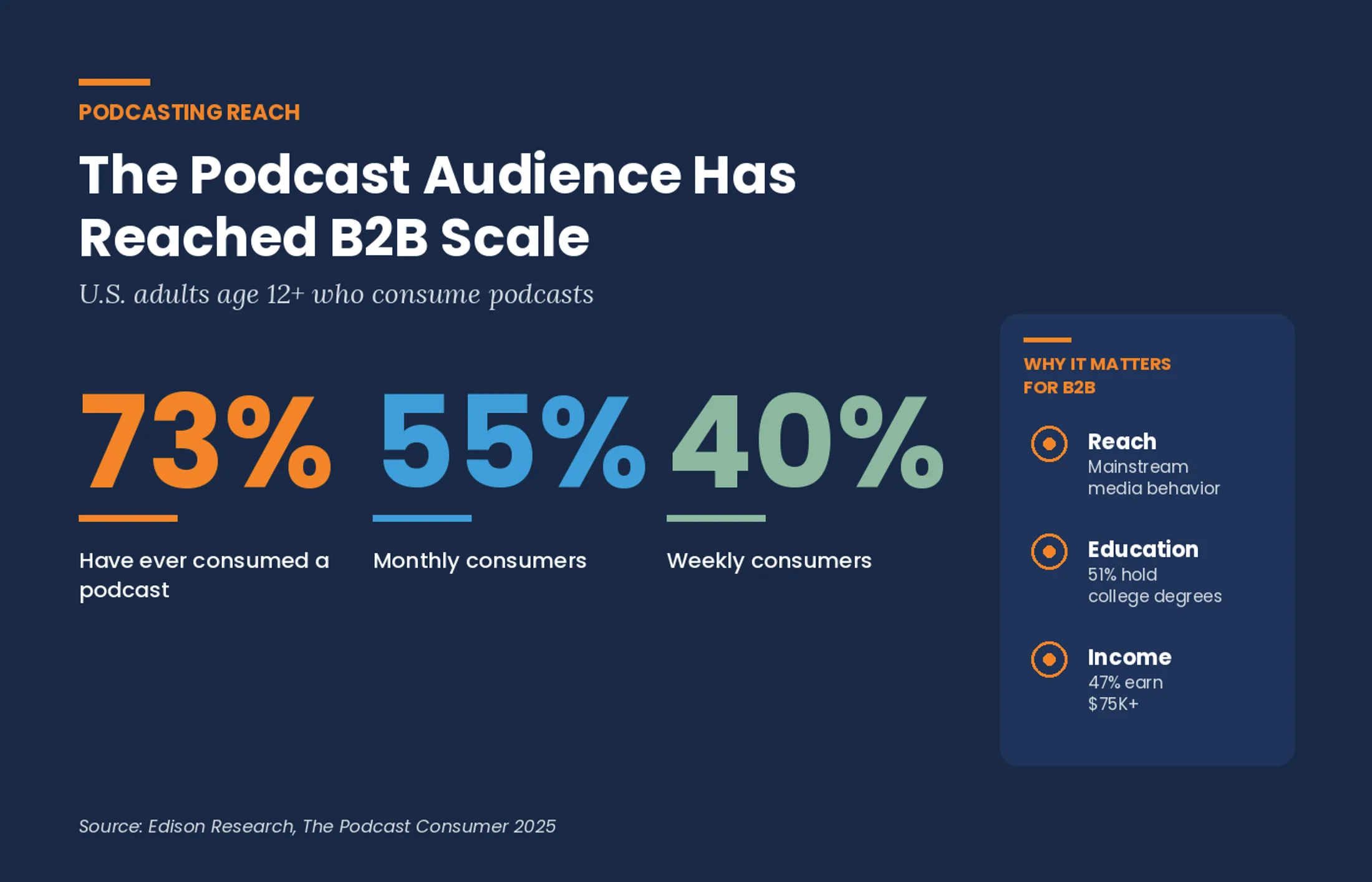
Podcasting is now a mainstream media behavior. Edison Research’s The Podcast Consumer 2025 found that 73% of the U.S. population age 12 and older has consumed a podcast, 55% consumed one in the last month, and 40% did so in the last week. That means podcasts are no longer a niche channel for early adopters. They are part of how people learn, evaluate ideas, and spend time with trusted voices.
For B2B brands, this matters because buyers are already overwhelmed by written content, sales emails, and digital ads. Podcasts reach people in moments when they are not sitting in front of a screen: commuting, walking, exercising, traveling, or doing focused work. That gives companies another way to earn attention without asking the audience to stop everything else.
The listener profile aligns with business audiences
The podcast audience also has qualities that matter to B2B marketers. Edison found that monthly podcast consumers skew higher-income and more educated than the general U.S. population, with 47% earning $75,000 or more and 51% holding college degrees. Weekly podcast consumers also show meaningful rates of business ownership.
This does not mean every podcast audience is a perfect B2B audience. It means the channel has enough reach and audience quality to justify strategic evaluation. A consulting firm, software company, financial services brand, or professional services firm can use podcasting to reach executives and decision influencers who prefer depth over quick promotional content.
Podcasts Build Trust Through Depth and Consistency
Long-form conversations help explain complex ideas
B2B buying decisions are usually complex. Buyers need to understand market shifts, risk, implementation, business value, and internal change. A 30-minute podcast conversation can explore those issues in a way a short post or campaign ad cannot.
This is where podcasting fits naturally into thought leadership. Strong thought leadership helps a company clarify what it believes, why it matters, and how customers should think differently about a business problem. A podcast gives leaders, subject matter experts, customers, analysts, and partners room to explain those ideas with context.
Voice creates familiarity with the company’s thinking
Trust grows through repeated exposure. A well-produced podcast gives the audience a steady rhythm of ideas, examples, and conversations. Over time, listeners begin to understand how the company sees the market.
This is different from occasional content bursts around product launches or campaigns. A podcast can create a regular editorial presence. That presence helps a company show judgment, not only expertise. For senior buyers, judgment often matters because they are not only evaluating a product. They are evaluating whether the company understands their business environment.
The host becomes a guide, not the entire brand
B2B podcasts often include visible executives or experts, but the goal should be broader than personal branding. A strong show should serve the company’s market position. The host matters because they make the experience human, but the editorial strategy should connect to the company’s category, customer issues, and strategic point of view.
That distinction is important. Personal branding centers on the visibility and reputation of an individual. Business thought leadership centers on the authority, trust, and influence of the organization. The best B2B podcasts can support both, but the strategy should start with the company’s business objectives.
Video Podcasts Expand the Value of Every Conversation
Video changes how podcasts are discovered
Podcasting is no longer only an audio format. Edison Research found that 51% of the U.S. population age 12 and older has consumed a video podcast, 37% are monthly video podcast consumers, and 26% are weekly video podcast consumers.
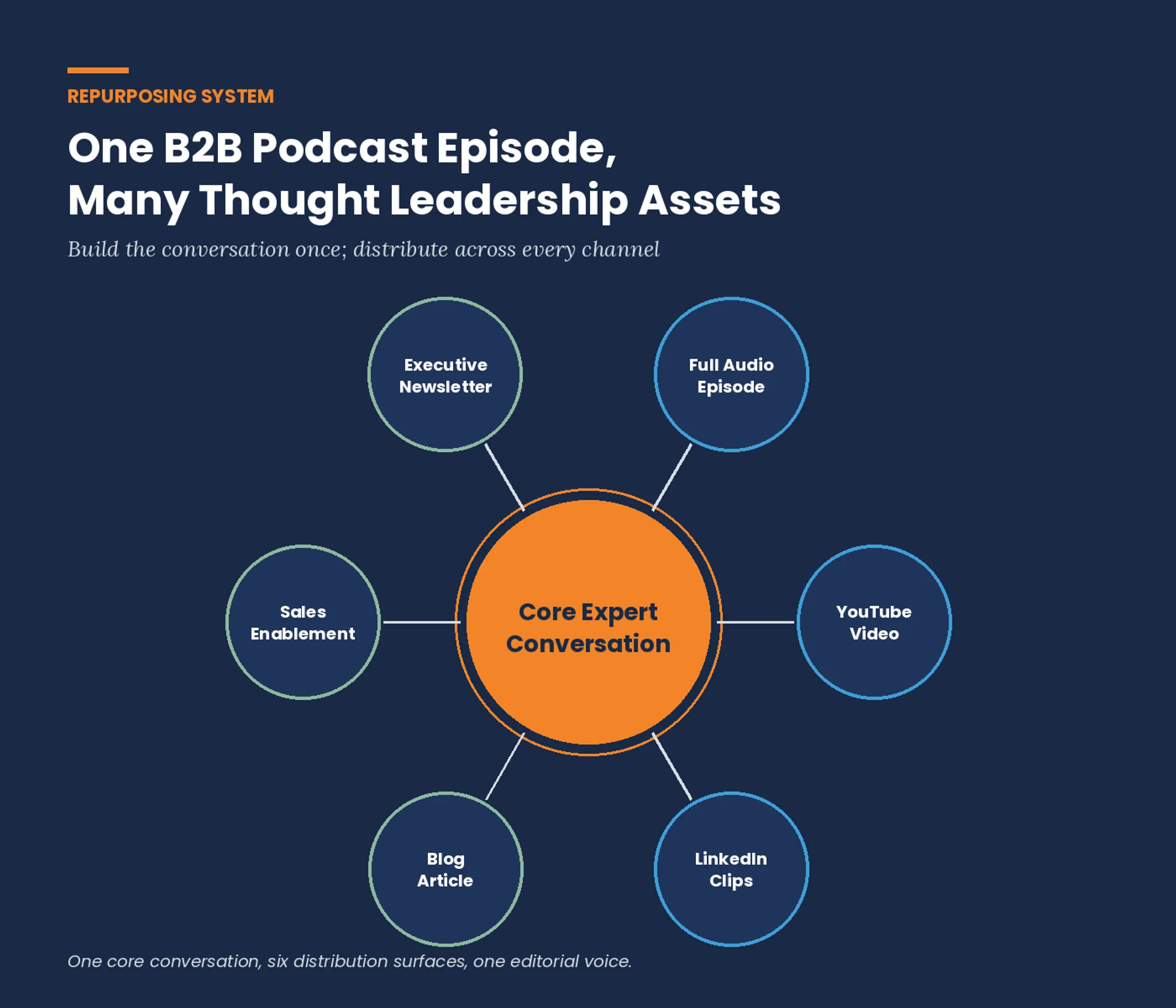
This shift has major implications for B2B content strategy. A recorded podcast can become a YouTube episode, a LinkedIn video clip, a newsletter feature, a blog post, a sales enablement asset, and short social content. One strong conversation can feed multiple channels without weakening the original idea.
Video helps humanize complex B2B topics
Many B2B categories are hard to explain because the value is abstract. Enterprise software, consulting, cybersecurity, financial services, professional services, and industrial technology often involve complex workflows and long sales cycles. Video podcasting gives companies a way to make those ideas more human.
Seeing an executive explain a market shift or a customer describe a transformation creates a different kind of connection. The audience can read tone, confidence, and clarity. That matters in markets where trust is built before a formal sales conversation begins.
Repurposing should protect the core idea
The danger with video podcasting is treating the recording as a clip factory. Repurposing is useful, but only when the original conversation has a clear point. A five-minute clip works better when it is taken from an episode built around a strong editorial question.
B2B teams should begin with the idea, then plan the assets. For example:
- Record a 35-minute conversation on a strategic market issue.
- Publish the full episode on audio and video channels.
- Create three short clips for LinkedIn.
- Turn the key insight into a blog article.
- Extract one customer-facing talking point for sales teams.
- Use the episode theme in a newsletter or executive briefing.
Podcasting Works Best as a Thought Leadership Engine
Start with a clear editorial point of view
A B2B podcast should begin with a strategic question: What should the market understand differently because our company is part of the conversation?
That question is more useful than starting with guest names or episode topics. It forces the company to define its editorial territory. A cybersecurity firm might focus on resilience and board-level risk. A consulting firm might focus on transformation that actually sticks. A fintech firm might focus on trust, speed, and compliance in modern finance.
The show should then return to that territory again and again from different angles. That repetition creates authority. It also helps the audience know what the company stands for.
Use guests to expand credibility
Guests can help a company avoid making the podcast feel too self-focused. Customers, analysts, partners, academics, authors, and industry operators can broaden the conversation. They also bring evidence and outside perspective.
The strongest guests are not always the most famous. For B2B thought leadership, useful guests often have direct experience with the problem the audience is trying to solve. A thoughtful operations leader, CIO, CFO, client executive, or field expert may create more value than a celebrity business author with broad but generic advice.
Build episodes around buyer-relevant tensions
The best B2B podcast topics usually come from tensions inside the market. Examples include:
- Growth versus efficiency
- Innovation versus risk
- Automation versus human judgment
- Speed versus governance
- Global scale versus local relevance
- Customer experience versus operational complexity
These tensions give the conversation energy. They also help the company show that it understands the tradeoffs buyers face. That is where thought leadership becomes useful to senior audiences.
Podcasts Can Influence the Hidden Buying Group
B2B decisions involve people sales teams may never meet
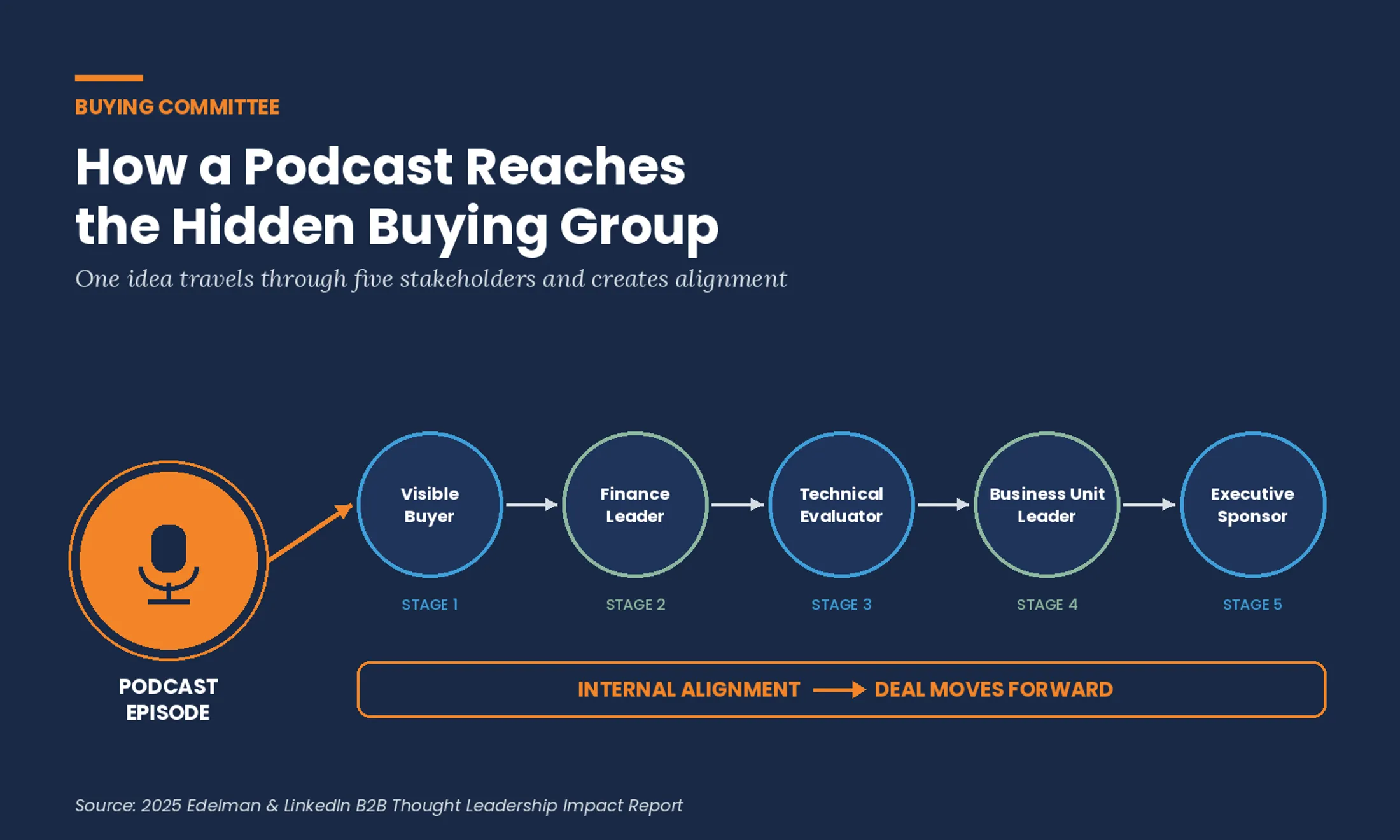
The buying committee is often larger than the visible sales conversation. The 2025 Edelman and LinkedIn B2B Thought Leadership Impact Report highlights the role of “hidden buyers,” internal influencers who may shape a deal even when they are not directly visible to a vendor. The report also notes that more than 40% of B2B deals stall because of internal misalignment within buying groups.
This is exactly where thought leadership matters. A podcast can reach people who are not ready to speak with sales but are ready to learn. It can give them language, examples, and confidence to discuss an issue internally.
Podcasts support internal alignment
A strong episode can travel inside a company. A buyer may send it to a colleague with a note like, “This is the issue we have been discussing,” or “This explains why our current approach is too narrow.” That kind of sharing is hard to track perfectly, but it can influence how buying groups frame the problem.
This is one reason downloads alone are an incomplete measure. A podcast with a small but senior audience may create more business value than a larger show with weak relevance. For B2B firms, the key question is not only “How many people listened?” It is also “Did the right people use the idea?”
How B2B Leaders Should Measure Podcast Success
Track authority signals beyond downloads
Downloads matter, but they should not be the only measure. B2B podcasting is often about depth of influence. Marketing leaders should track a broader set of authority signals, such as:
- Repeat listeners
- Guest quality and referral strength
- Executive audience engagement
- Newsletter signups from episode pages
- LinkedIn engagement from clips
- Sales team usage
- Account-level content engagement
- Invitations to speak, partner, or contribute
These signals show whether the podcast is strengthening the company’s presence in the market.
Connect podcast content to business development
A podcast should also support revenue activity. This does not mean every episode needs a sales pitch. It means the show should create useful conversations that connect to customer needs.
For example, a consulting firm might use an episode on operating model redesign to open a board-level discussion. A software company might use a customer interview to help prospects understand implementation change. A financial services firm might use a regulatory trends episode to support account-based outreach.
The podcast becomes most valuable when marketing, sales, and leadership teams know how to use it.
Measure content reuse across the organization
A well-run podcast can improve content efficiency. One episode can produce insights for demand generation, executive communications, sales enablement, analyst relations, social media, and customer education.
Teams should track how often episodes are repurposed and where they create value. If a podcast regularly produces blog posts, sales talking points, executive LinkedIn posts, and customer follow-up assets, its value is larger than the listening dashboard suggests.
What Companies Should Do Before Launching a B2B Podcast
Define the strategic role first
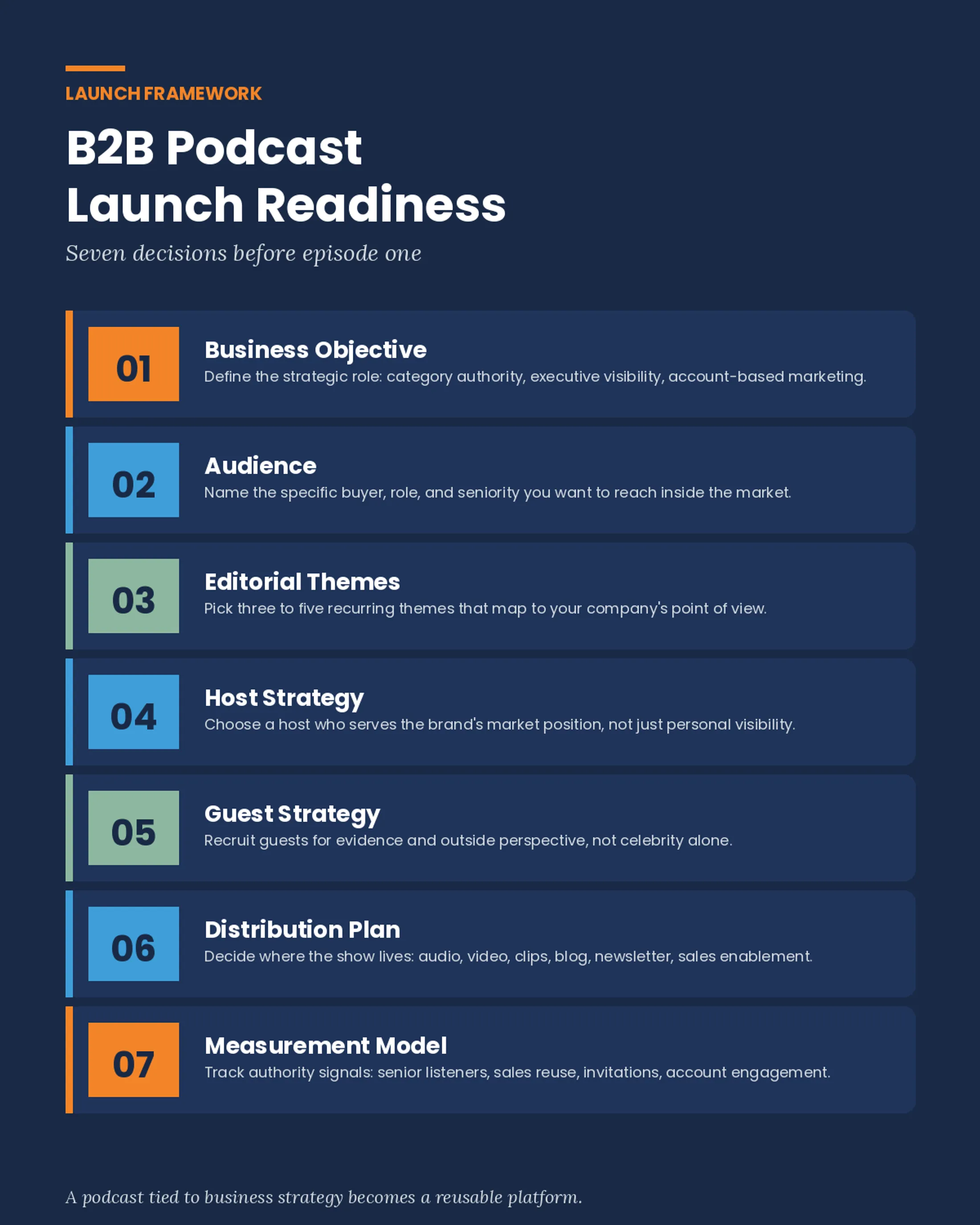
Before choosing a name, format, or guest list, leaders should define the podcast’s business role. Is the goal to build category authority? Strengthen executive visibility? Support account-based marketing? Deepen customer relationships? Influence a technical audience? Create a platform for partner conversations?
A podcast without a clear role can quickly become a production burden. A podcast tied to business strategy becomes a reusable platform.
Create an editorial architecture
Strong podcasts need structure. That structure should include:
- A core audience definition
- A clear market problem
- Three to five recurring editorial themes
- A guest strategy
- A publishing cadence
- A repurposing plan
- A measurement model
This architecture keeps the show focused. It also makes it easier to produce episodes consistently without chasing random topics.
Commit to quality and consistency
Podcasting rewards consistency. A small number of strong episodes can help launch a show, but trust grows when the audience sees a reliable pattern. That does not always mean weekly publishing. For many B2B companies, a high-quality biweekly or monthly show may be more realistic.
Production quality also matters. The audience does not expect a Hollywood studio, but they do expect clear sound, a prepared host, a focused conversation, and useful takeaways. Poor production can weaken credibility, especially when the company serves senior buyers.
The Strategic Takeaway for B2B Companies
Podcasting belongs in the B2B thought leadership conversation because it supports the way modern buyers learn. It gives companies a recurring format for explaining complex ideas, building trust, featuring credible voices, and creating content that can be reused across the business.
The next step for executives and senior marketers is to treat podcasting as part of a broader authority-building system.
When a podcast is tied to business strategy, editorial discipline, and buyer insight, it can become more than a show. It can become a durable expression of how the company thinks, leads, and helps the market move forward.