

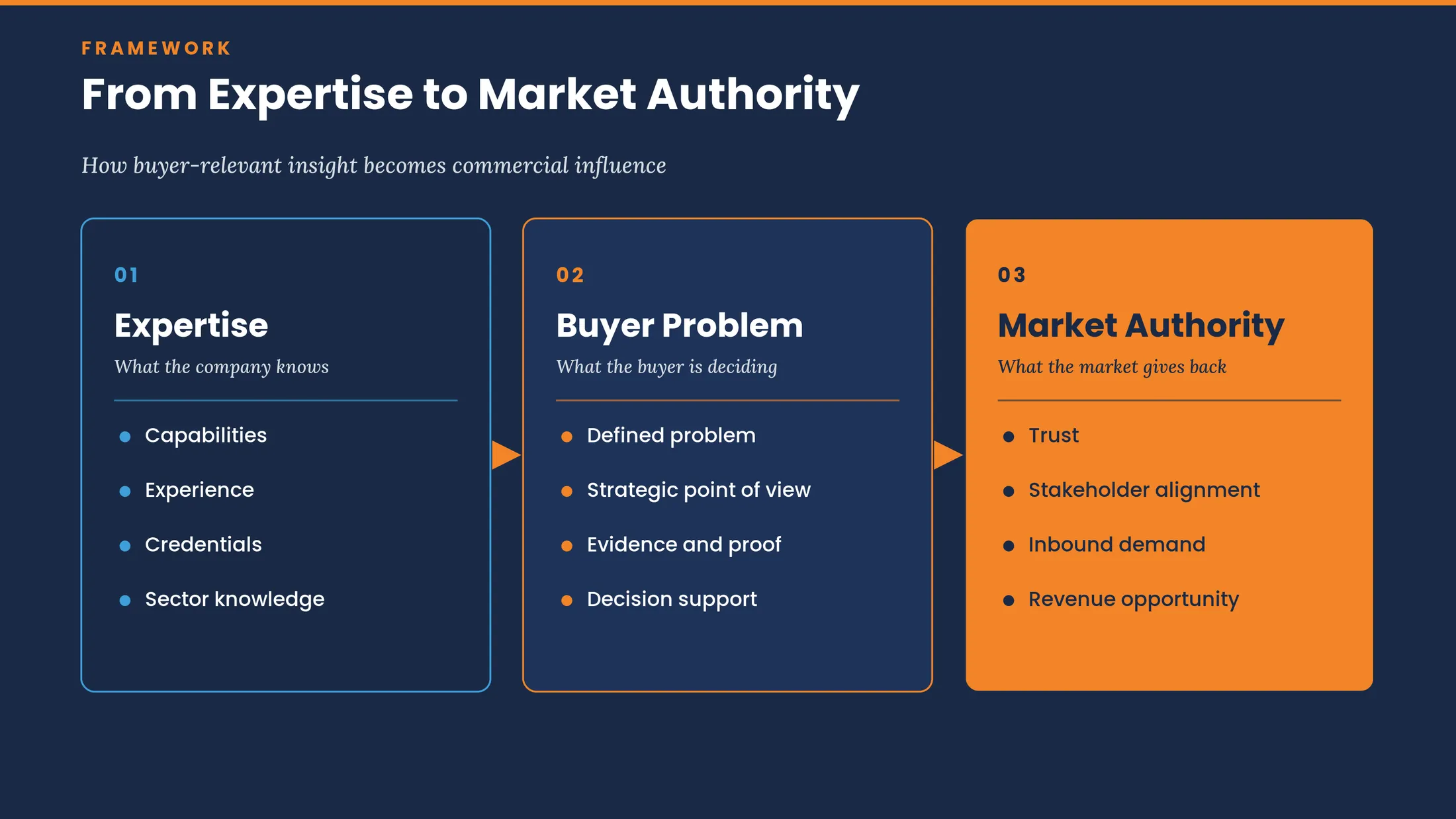
Many companies have deep expertise, respected leaders, strong client relationships, and years of proven performance. Yet that expertise often fails to create market authority because it is communicated as capability rather than as a clear answer to a buyer’s urgent business problem.
This is one of the central challenges in corporate thought leadership. Companies often believe the market should value the full range of what they know. Buyers usually see it differently. They are not trying to evaluate every capability a company can offer. They are trying to make a difficult decision, reduce risk, align internal stakeholders, and move the business forward.
That distinction changes the purpose of thought leadership. Effective thought leadership does more than demonstrate expertise. It helps buyers understand a problem more clearly, see why it matters now, and build confidence in a path to action.
Expertise Is the Starting Point, Not the Market Position
Buyers are not searching for broad capability statements
Inside an organization, breadth is valuable. Companies build advantage by connecting strategy, operations, technology, talent, finance, and customer needs. Executive teams understandably want the market to see the full depth of that experience.
But buyers do not enter the market looking for a complete inventory of capabilities. They usually begin with a specific pressure point.
A CEO may be trying to restore growth after two flat quarters. A CFO may be questioning whether a transformation investment is creating measurable return. A CMO may be under pressure to prove that brand and demand programs are influencing the pipeline. A CIO may be trying to scale AI without creating governance exposure.
When thought leadership leads with broad expertise, it asks the audience to do the translating. Prospects have to connect the company’s knowledge to the specific decision in front of them. Senior executives don’t have time for that work. They respond to ideas that already reflect the problem they are trying to solve.
Authority comes from specificity
Market authority grows when a company becomes associated with a problem that matters.
A firm that says it helps companies “navigate transformation” may sound credible. A firm that explains why transformation programs lose momentum after technology implementation, and how leadership teams can close the adoption gap, becomes more useful.
Specificity does not narrow authority. It sharpens it. It tells the market where the company has pattern recognition, where it has a distinct point of view, and where it can help buyers make better decisions.
This is especially important in consulting, technology, finance, and professional services. Many firms in these categories can claim senior talent, sector knowledge, and experience with complex clients. The firms that stand out are often the ones that define the buyer’s problem better than competitors do.
Generic thought leadership weakens differentiation
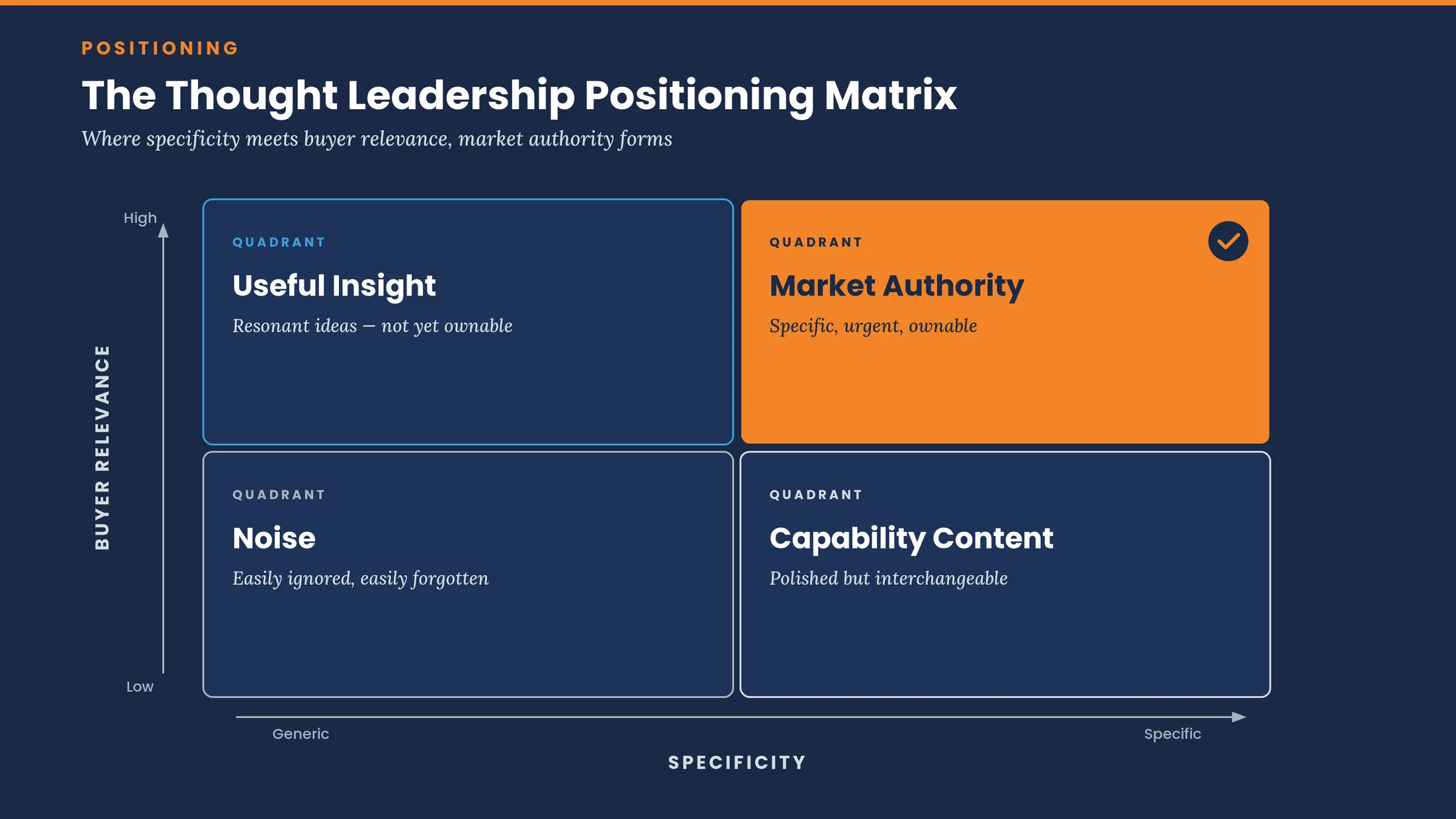
Generic thought leadership may be polished, accurate, and professionally produced. It can still feel interchangeable.
Momentum ITSMA’s 2025 research draws on insights from 600 leaders at large organizations, with more than two-thirds representing companies that generate more than $1 billion in annual revenue. The report focuses on how thought leadership builds trust, influences decisions, and supports more client-centric experiences. (MomentumABM)
For executive teams, the implication is clear. Thought leadership should not simply show that the company understands a trend. It should show that the company understands the buyer’s decision better than the market conversation does.
Thought Leadership Should Translate Expertise Into Buyer Urgency
The buyer’s problem should be visible immediately
Strong thought leadership begins where the buyer already feels pressure.
That pressure may come from the board, investors, customers, regulators, employees, competitors, or internal performance targets. In most cases, the buyer is not simply looking for information. The buyer is looking for clarity.
That means corporate thought leadership should begin with a buyer decision, not a company message.
Before developing an article, report, executive briefing, keynote, or campaign, leadership teams should ask:
- What decision is the buyer trying to make?
- What risk makes that decision difficult?
- What internal disagreement may slow the decision?
- What evidence would help the buyer move forward?
- What point of view can we offer that the market is missing?
These questions shift thought leadership away from promotion and toward decision support.
Strong ideas reduce perceived risk
B2B decisions carry real consequences. A poor technology choice, weak transformation strategy, delayed market response, or failed operating model can affect revenue, credibility, customer trust, and executive careers.
That is why thought leadership has value beyond visibility. It can reduce uncertainty. It can help buyers compare options. It can give internal champions language they can use with finance, procurement, legal, operations, and executive sponsors.
The most useful thought leadership gives buyers a clearer way to understand what is at stake. It does not simply say, “This trend matters.” It explains why the trend matters now, what leaders may be underestimating, and what a better decision process should look like.
Market authority is built before sales has access
Many buyers form their view of a company before speaking with sales.
Gartner reported in June 2025 that 61% of B2B buyers prefer an overall rep-free buying experience. The same Gartner release noted that 73% of B2B buyers actively avoid suppliers that send irrelevant outreach. (Gartner)
This creates a strategic role for thought leadership. It becomes the company’s early presence in the buying journey. It can shape how buyers understand the issue, compare options, evaluate risk, and decide which providers deserve attention.
The Hidden Buyer Changes the Role of Thought Leadership
Buying groups are larger than the visible decision-maker
Complex B2B decisions are not made by one executive. Even when one leader appears to own the decision, many other stakeholders influence whether the action moves forward.
Edelman and LinkedIn’s 2025 B2B Thought Leadership Impact Report highlights the role of “hidden buyers,” the internal stakeholders who influence decisions even when they are not visible to sellers. The report says more than 40% of B2B deals stall because of internal misalignment within buying groups. (Edelman)
These hidden buyers may sit in finance, procurement, legal, compliance, IT, operations, human resources, regional leadership, or the executive committee. Each sees the decision through a different lens. One may question cost. Another may worry about implementation risk. Another may need evidence of adoption. Another may want proof that the initiative supports enterprise strategy.
Thought leadership can reach these stakeholders in ways direct selling often cannot.
Insight travels where sales conversations do not
A strong article, report, diagnostic, or executive framework can be forwarded, quoted, debated, and used inside internal meetings. It gives champions language they can carry into conversations where the provider is not present.
That is why repeatability matters. If an executive cannot explain the core idea in one sentence after reading it, the thought leadership may not travel.
The best thought leadership gives buyers words for what they already sense but have not fully articulated. It helps them say, “This is the issue we are facing,” “This is why our current approach is not enough,” and “This is the decision we need to make.”
That kind of clarity creates internal momentum.
Alignment is a commercial outcome
Many stalled deals are not caused by lack of interest. They are caused by lack of agreement.
Stakeholders may agree that a problem matters while disagreeing on urgency, budget, ownership, timing, or acceptable risk. Thought leadership can help resolve that tension by giving the buying group a shared frame.
A cybersecurity company should not only publish on emerging threats. It should help executives understand the business trade-offs behind cyber resilience. A consulting firm should not only describe transformation trends. It should clarify why certain operating models fail under scale. A technology company should not only explain product innovation. It should help leaders evaluate readiness, governance, adoption, and measurable value.
This is where thought leadership moves from content to influence.
The Positioning Test: Can Your Idea Be Repeated in a Boardroom?
Make the problem specific enough to remember
Executive thought leadership should pass a simple test: Can the idea be repeated in a boardroom without the original author present?
If the idea depends on vague language, long explanations, or category jargon, it will struggle to travel. If it names a real business tension in clear language, it becomes useful.
Strong positioning often includes five elements:
- A problem the market recognizes
- A tension leaders feel but may not have named
- A point of view on why current approaches fall short
- Evidence that makes the argument credible
- A path forward that supports action
This structure is often missing from corporate content. Too many companies publish around broad themes instead of executive decisions. They discuss innovation, resilience, transformation, customer experience, AI, growth, and efficiency without defining the specific decision their buyers are trying to make.
Move from category participation to category ownership
Many companies participate in broad market conversations. Fewer own a valuable point of view within those conversations.
Category participation sounds like this: “The future of AI in financial services.”
Category ownership sounds more like this: “Why AI pilots fail to scale in regulated financial institutions, and how governance should change before deployment expands.”
The second idea is stronger because it names the buyer, the problem, the risk, and the strategic implication. It is easier for marketing to build a campaign around, easier for sales to use in executive conversations, and easier for clients to remember.
Replace content volume with strategic coherence
More content does not automatically create more authority. In some cases, it creates more noise.
Content Marketing Institute’s 2025 B2B research found that 45% of B2B marketers lack a scalable model for content creation. The same research found that only 22% describe their content marketing as extremely or very successful, while top performers are more likely to have effective strategy, the right technology, scalable creation models, and effective performance measurement. (Content Marketing Institute)
This points to a leadership issue, not only a marketing issue. Thought leadership should be tied to the company’s strategic priorities, buyer needs, and commercial goals. Without that alignment, teams often produce content that fills channels but does not build market authority.
How Executive Teams Can Turn Expertise Into Thought Leadership That Sells
Start with the buyer’s decision
The best thought leadership programs begin by identifying the decision point the buyer is facing.
For a technology firm, that decision may involve whether to modernize infrastructure, consolidate vendors, invest in AI, or rethink data governance. For a consulting firm, it may involve whether to redesign the operating model, enter a new market, restructure costs, or accelerate transformation. For a financial services firm, it may involve risk, capital allocation, customer trust, or regulatory readiness.
Once the decision is clear, the content strategy becomes sharper. The company can identify the questions buyers are asking, the doubts hidden stakeholders may raise, and the evidence needed to support action.
Define the company’s strategic point of view
A strategic point of view gives the market a reason to listen.
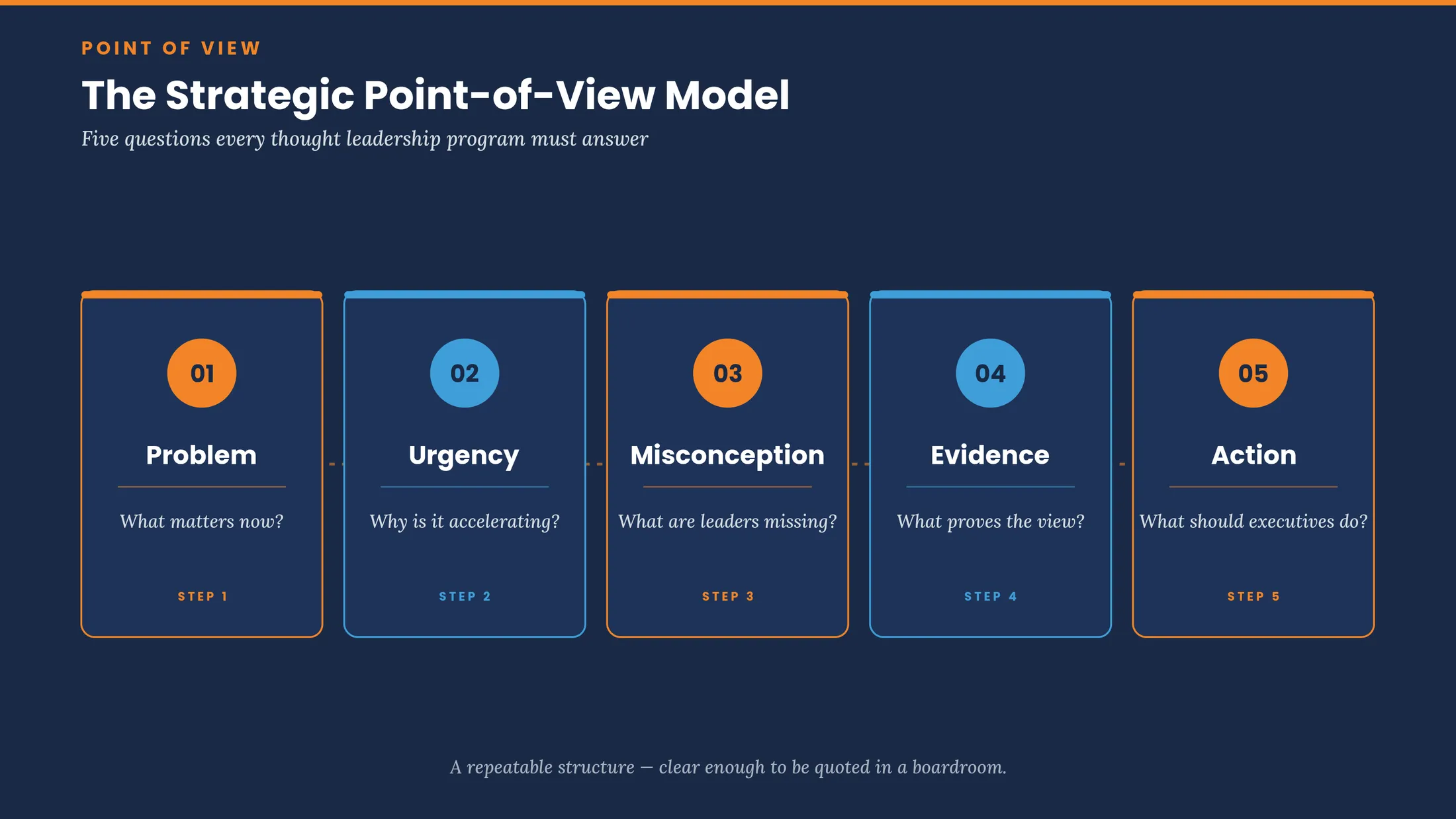
It should answer five questions:
- What problem matters now?
- Why is the problem becoming more urgent?
- What are leaders underestimating?
- What evidence supports our view?
- What should executive teams do differently?
This is where thought leadership becomes distinct from general content marketing. It takes a position. It offers interpretation. It helps buyers see around corners.
Build proof around outcomes
Executives trust ideas that are supported by proof.
Proof can come from proprietary research, client patterns, operational data, expert interviews, case examples, financial modeling, or field experience. The form matters less than the credibility. Buyers want to see that the company is not simply commenting on a trend. They want evidence that the company understands what drives outcomes.
This is especially important as AI increases the volume of generic content. Content Marketing Institute found that 54% of B2B marketers take an ad hoc approach to AI, while only 19% say AI is integrated into daily processes and workflows. The same research found that only 4% report a high level of trust in generative AI outputs. (Content Marketing Institute)
As content becomes easier to produce, proof becomes more valuable. The market will reward companies that bring original insight, credible evidence, and useful judgment.
Align leadership, marketing, sales, and subject matter experts
Thought leadership gains power when it is not treated as a marketing asset alone.
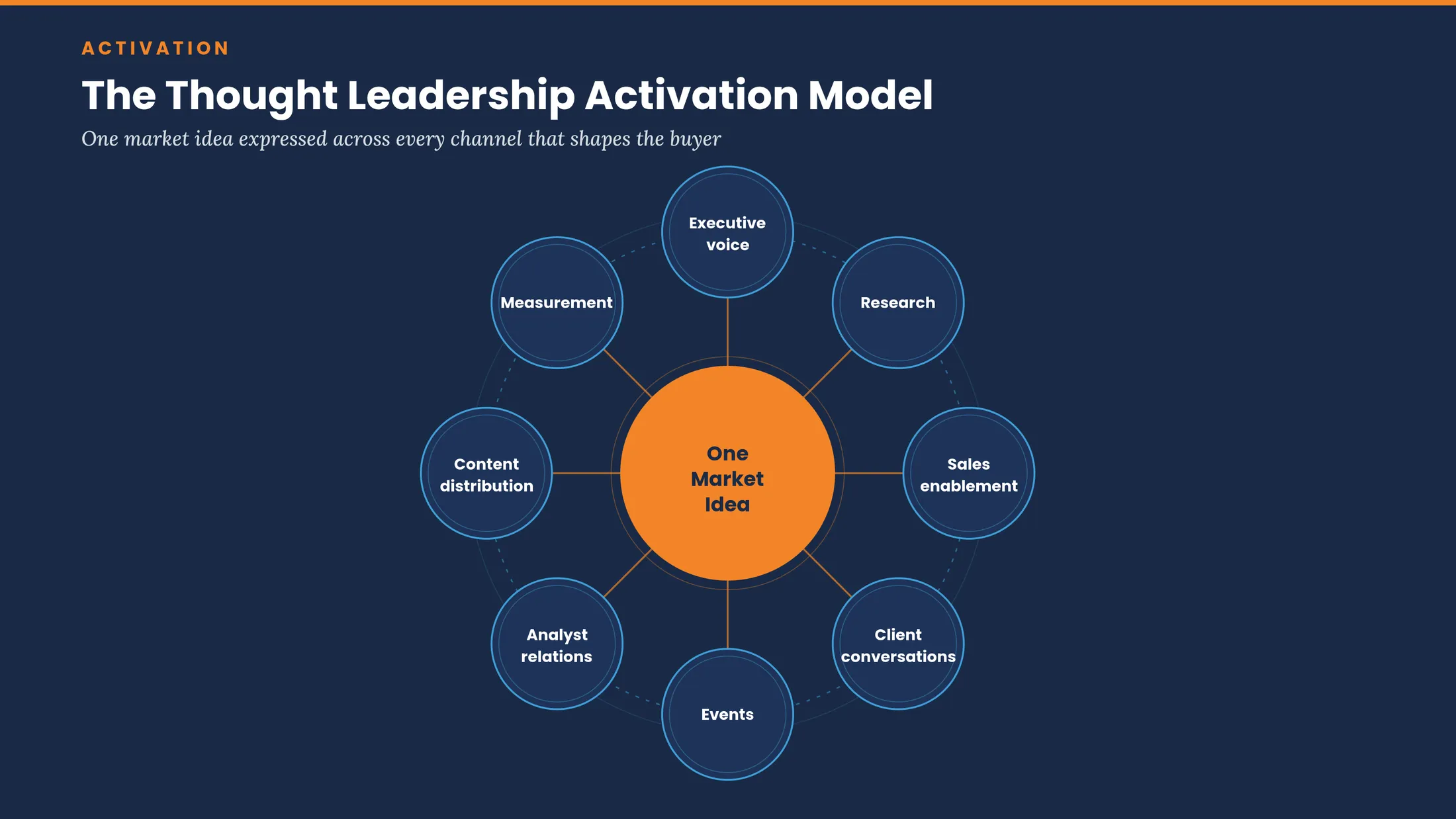
The strongest programs align the executive team, marketing, sales, communications, client leaders, and subject matter experts around a clear market idea. That idea can then shape articles, research reports, keynote themes, sales conversations, webinars, analyst briefings, client events, and executive social content.
This creates consistency. Buyers hear the same core argument across channels, adapted to their stage of the journey and role in the buying group.
From Visibility to Market Authority
Visibility alone does not create influence
Awareness matters, but awareness without relevance has limited commercial value.
A company can be visible in the market and still fail to shape buyer decisions. It can publish frequently and still sound like competitors. It can have respected experts and still struggle to connect its knowledge to revenue opportunity.
Authority grows when the market associates the company with a problem that matters.
Buyers choose companies that clarify the decision
Corporate credentials, past performance, and technical depth all matter. They support credibility. But they do not automatically create demand.
Demand grows when buyers believe a company understands their problem better than anyone else. It grows when the company gives buyers sharper language, stronger evidence, and a clearer path to action. It grows when internal champions can use the company’s ideas to build confidence across the buying group.
That is the real work of thought leadership. It turns expertise into a market-facing idea that helps buyers make progress.
The executive mandate
The mandate for leadership teams is straightforward: stop presenting expertise as a broad capability story. Start shaping the market’s understanding of a specific problem.
That shift requires focus. It asks companies to choose the issues they want to be known for, develop a clear point of view, support it with proof, and activate it across the business.
The companies that do this well become more than visible. They become useful to buyers before the buying process is fully visible. They help leaders reduce risk, align stakeholders, and make decisions with greater confidence.
That is the difference between having expertise and earning market authority.